
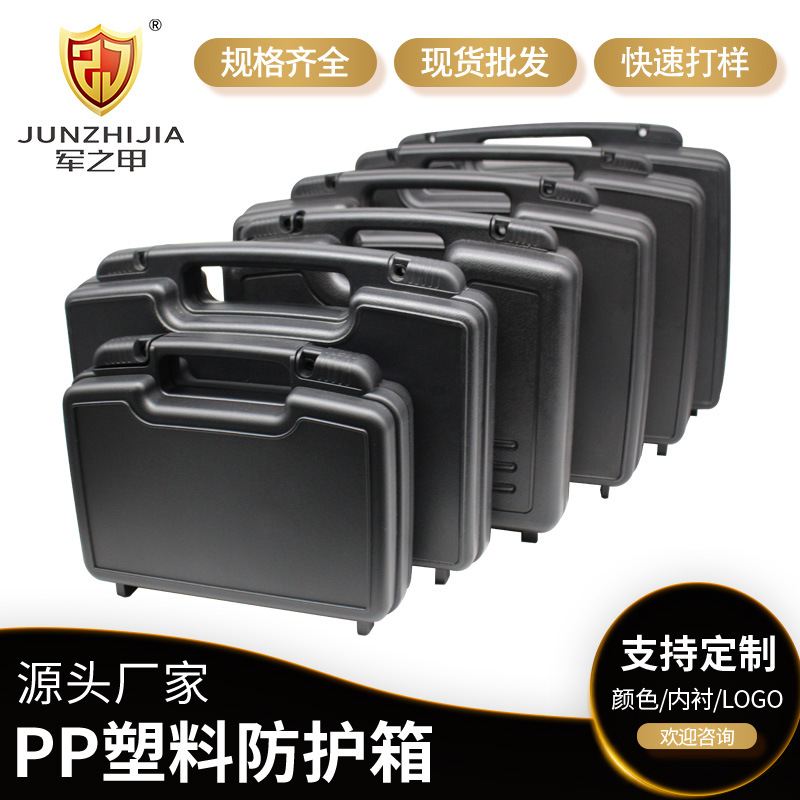
The material composition of a protective case determines its fundamental performance characteristics—impact resistance, weight, chemical compatibility, temperature tolerance, and service life. Understanding the differences between the four primary engineering plastics used in protective case manufacturing—PP, ABS, PC, and PE—is essential for making informed procurement decisions. This comprehensive guide examines each material's properties, advantages, limitations, and ideal application scenarios.
Polypropylene (PP): The Lightweight Workhorse
Polypropylene is the most widely used material in protective case manufacturing, and for good reason. PP offers the best strength-to-weight ratio among common engineering plastics, with a density of approximately 0.90–0.91 g/cm³—the lightest of all four materials discussed here. This makes PP cases exceptionally portable without sacrificing structural integrity.
PP exhibits outstanding chemical resistance, withstanding exposure to most acids, alkalis, organic solvents, and cleaning agents. This property makes PP cases ideal for laboratory, medical, and industrial environments where chemical spills are a concern. The material is also non-toxic and FDA-compliant for food contact applications, making it suitable for pharmaceutical and food industry transport containers.
In terms of mechanical properties, PP demonstrates excellent fatigue resistance—it can be repeatedly flexed without cracking, which is crucial for hinge mechanisms and latch points. PP's impact resistance is very good at room temperature, though it drops noticeably in sub-zero conditions. The typical operating temperature range for standard PP is -20°C to +100°C, with specialized copolymer grades extending this range further.
KeXin's 1-Series and 8-Series cases utilize high-grade impact-modified PP copolymers that maintain toughness even at low temperatures. The material is injection-molded into precisely dimensioned cases with consistent wall thickness, ensuring uniform protection across the entire shell. PP's natural translucency in thinner sections allows for visual inspection of contents, while solid colors with UV stabilizers provide excellent outdoor durability.
ABS (Acrylonitrile Butadiene Styrene): The Premium Finish Choice
ABS is a terpolymer that combines the strength of acrylonitrile, the toughness of butadiene, and the processability of styrene. It is renowned for its hard, glossy surface finish—a property that makes ABS cases visually superior and easier to clean than PP alternatives. ABS has a density of approximately 1.04–1.06 g/cm³, making it moderately heavier than PP but still manageable for portable applications.
The key advantage of ABS over PP is its exceptional dimensional stability. ABS cases maintain their precise shape across a wide range of temperatures and environmental conditions, with very low shrinkage and warpage. This is critical for applications requiring tight tolerances, such as cases with complex internal mounting points or those used as instrument calibration enclosures.
ABS offers good impact resistance—better than standard PP at room temperature—though it can become brittle in very cold conditions. Its scratch resistance is excellent, preserving the case's professional appearance through years of field use. ABS also accepts paint, plating, and printing more readily than PP, providing more options for branding and customization.
KeXin's 6-Series cases are manufactured from premium ABS grades selected specifically for their balance of surface quality, impact resistance, and chemical stability. These cases feature a distinctive matte or textured finish that resists fingerprints and minor abrasions, maintaining a presentable appearance even in demanding professional settings such as trade shows, field service, and military briefings.
Polycarbonate (PC): Maximum Impact and Transparency
Polycarbonate is the premium option for protective cases requiring maximum impact resistance and optical transparency. With an unnotched Izod impact strength exceeding 600 J/m, PC is virtually unbreakable under normal use conditions—a property leveraged in bulletproof glass, riot shields, and aerospace applications. PC's density of 1.20–1.22 g/cm³ makes it the heaviest material in this comparison, but the weight trade-off is justified where ultimate protection is required.
The standout characteristic of PC is its transparency. PC cases allow full visual inspection of contents without opening, which is invaluable for equipment verification, inventory management, and security screening. PC maintains 88–90% light transmission with excellent optical clarity, comparable to glass but with 250 times the impact resistance.
PC's heat resistance is superior to both PP and ABS, with a glass transition temperature around 147°C and continuous service temperature up to 125°C. This makes PC cases suitable for applications involving sterilization, hot equipment storage, or deployment in high-temperature environments. PC also exhibits good electrical insulation properties and inherent flame retardancy (UL 94 V-2 or better).
However, PC has limitations. It is susceptible to stress cracking when exposed to certain chemicals, particularly aromatic hydrocarbons, ketones, and strong alkalis. PC also requires UV stabilization for outdoor use, as unmodified PC will yellow and become brittle with prolonged sun exposure. KeXin's transparent cases using PC materials incorporate advanced UV-stabilized formulations and chemical-resistant coatings to mitigate these concerns.
High-Density Polyethylene (HDPE): Flexible and Cold-Resistant
HDPE offers a unique combination of flexibility, chemical resistance, and cold-temperature toughness that distinguishes it from the other materials. With a density of 0.94–0.97 g/cm³, HDPE is slightly heavier than PP but significantly more flexible, allowing the case to absorb impacts through deformation rather than cracking.
HDPE's defining characteristic is its exceptional low-temperature performance. Unlike other plastics that become brittle in freezing conditions, HDPE maintains its ductility down to -40°C and below. This makes HDPE the material of choice for arctic expeditions, cold storage logistics, and winter military operations. HDPE also demonstrates excellent environmental stress crack resistance (ESCR), meaning it withstands long-term exposure to chemicals and detergents without developing micro-cracks.
Large rotomolded cases are nearly always manufactured from HDPE or specialized LLDPE (Linear Low-Density Polyethylene) grades. The rotomolding process—in which powdered PE is heated and rotated biaxially inside a mold—produces seamless, stress-free cases with uniform wall thickness. KeXin's rotomolded product line leverages premium HDPE grades for large-format cases that withstand extreme environments from desert heat to polar cold.
Comprehensive Material Comparison Table
| Property | PP | ABS | PC | HDPE |
|---|---|---|---|---|
| Density (g/cm³) | 0.90–0.91 | 1.04–1.06 | 1.20–1.22 | 0.94–0.97 |
| Impact Resistance | Very Good | Good | Excellent | Good |
| Cold Toughness | Down to -20°C | Down to -10°C | Down to -30°C | Down to -40°C |
| Max Service Temp | +100°C | +80°C | +125°C | +80°C |
| Chemical Res. | Excellent | Moderate | Limited | Excellent |
| Surface Finish | Matte | High Gloss | Clear | Matte |
| Relative Cost | Low | Medium | High | Low-Med |
| Best For | General Use | Professional Display | Max Protection | Cold Environments |
Processing Methods and Their Impact
The manufacturing process significantly influences material selection. Injection molding—used for PP, ABS, and PC cases—produces parts with excellent dimensional accuracy, repeatable quality, and cost-effectiveness at volumes of 500 units and above. The process does require higher initial mold investment but yields lower per-unit costs at scale.
Rotational molding, almost exclusively used for HDPE/LLDPE cases, offers lower mold costs—typically 30–50% of injection mold cost—making it economical for smaller production runs and very large case sizes. Rotomolded cases have stress-free, seamless walls without weld lines that could become failure points under impact.
Application-Based Selection Guide
General Equipment Transport: PP cases (KeXin Series 1 or 8) offer the optimal balance of protection, weight, and cost for most professional equipment transport scenarios including field service, audio-visual gear, and instrumentation.
Premium Presentation and Professional Display: ABS cases (KeXin Series 6) provide a superior finish that reflects your brand quality. Ideal for sales demonstrations, trade show exhibits, and executive equipment transport.
Maximum Protection and Visibility: PC cases are recommended for high-value optical equipment, medical devices requiring sterilization, and applications where visibility of contents is critical for safety or efficiency.
Extreme Cold and Chemical Environments: HDPE rotomolded cases are essential for arctic operations, cold chain logistics, chemical industry transport, and applications requiring maximum long-term durability under harsh conditions.
Environmental and Sustainability Considerations
All four materials are fully recyclable (recycling codes: PP=5, ABS=7, PC=7, HDPE=2). PP and HDPE have the most established recycling infrastructure globally. KeXin is actively developing recycled-content grades for applications where specifications permit, reducing the environmental footprint of our cases without compromising protective performance.
Conclusion
There is no single "best" material for protective cases—each plastic serves specific requirements that make it optimal for particular applications. PP offers the lightest weight and best cost-value ratio; ABS provides superior finish and dimensional precision; PC delivers unmatched impact protection and transparency; and HDPE excels in cold-weather and chemical-exposure scenarios. KeXin's multi-material manufacturing capability ensures we can recommend and produce the right case for your exact needs, drawing from 25 years of material expertise in protective case engineering.